Professional services

Get the hard parts of your configurator shipped

Work directly with the people building confBuild to turn product rules, CAD data, spreadsheets, and target outputs into a working system your team can own.

  • A working scope before development starts
  • Small validation loops instead of a long hidden build
  • Documentation and handoff included
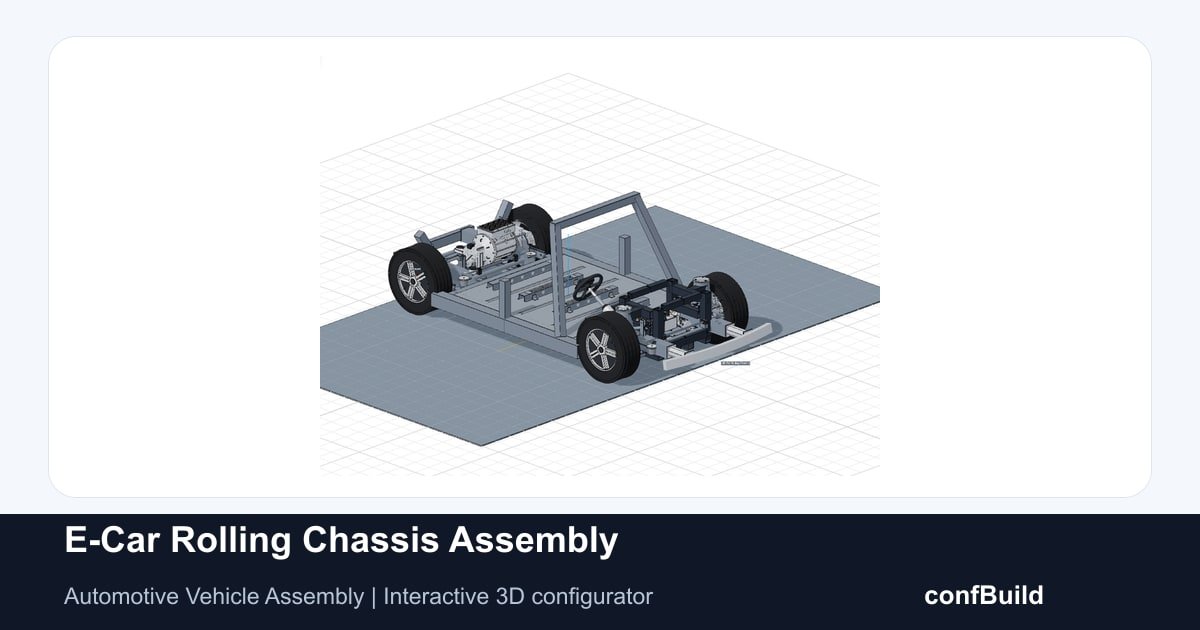
Public model example Public confBuild E-Car Rolling Chassis assembly project E-Car Rolling Chassis Assembly A multi-part configurable system with structure, motion, and reusable subassemblies.
Choose by bottleneck

Where do you need momentum?

Start with one defined problem. The engagement can stop after a focused result or continue into the next delivery stage.

01 Model + interaction

Configurator Build

Turn an existing product family or concept into a controlled 3D configurator with reusable geometry and clear user choices.

Use this when you know what must be configurable but do not yet have a robust model architecture.
  • Parametric model
  • Product rules
  • Interaction design
  • Reusable subparts
02 Data + outputs

Workflow Integration

Connect model state to the files, data sources, embedded experiences, and operational handoffs around it.

Use this when the model works, but information is still copied manually between tools or teams.
  • Data mapping
  • BOM and exports
  • Embedding
  • API handoff
03 Reduce + validate

Simulation Preparation

Reduce a configurable assembly to a solver-ready surrogate and establish a repeatable path into structural, thermal, fluid, or electromagnetic analysis.

Use this when configuration geometry must become dependable simulation input rather than a one-off export.
  • Model reduction
  • Boundary setup
  • Solver handoff
  • Result review
04 Review + transfer

Team Enablement

Review an existing implementation, resolve structural problems, and teach the team how to extend the workflow safely.

Use this when you want internal ownership without learning every architectural lesson the hard way.
  • Architecture review
  • Working sessions
  • Documentation
  • Rollout plan
Working together

One visible delivery loop

Every stage produces something reviewable. Scope and decisions stay visible, so the team can correct direction before complexity compounds.

  1. 01

    Frame the problem

    Review the current process, representative source data, users, constraints, and the output that matters first.

    Outcome: a bounded first milestone and an explicit definition of done
  2. 02

    Build the thin path

    Implement the smallest complete route from input through model behavior to the chosen output.

    Outcome: a working slice that can be tested with real cases
  3. 03

    Test the edge cases

    Run representative variants, check failure modes, and refine rules, interaction, and handoffs.

    Outcome: validated behavior and a documented decision trail
  4. 04

    Transfer ownership

    Clean up the structure, document operation and extension points, and walk the responsible team through it.

    Outcome: a maintainable workflow with clear next steps
You bring

Enough context to test reality

  • A representative product, assembly, or workflow
  • Current CAD, spreadsheets, rules, or example files
  • The people who understand exceptions and downstream use
  • One outcome that should work first
You keep

Artifacts your team can continue using

  • Working implementationModel logic, controls, automation, or integration code agreed in scope.
  • Decision recordImportant assumptions, constraints, and architecture choices in writing.
  • Validation casesRepresentative configurations and checks for the critical workflow path.
  • Handoff materialOperating notes, extension points, and a guided team walkthrough.
Good fit

This works well when

  • There is a real product or process to use as the test case
  • The first useful outcome can be named and reviewed
  • Domain experts can answer questions about rules and exceptions
  • The team wants to own the result after handoff
Probably not yet

Start elsewhere when

  • The goal is only a presentation concept with no implementation path
  • No representative data, rules, or decision owner is available
  • The scope must remain completely fixed before any real case is tested
  • A general-purpose outsourcing team is needed for unrelated software work

Have one difficult workflow in mind?

Send a representative example, the current process, and the result that should work first. We will use that to define a useful starting point.